
Distinguished Professor and Founding Chair,
Department of Biomedical Informatics
SUNY Empire Innovation Professor Department of Computer Science
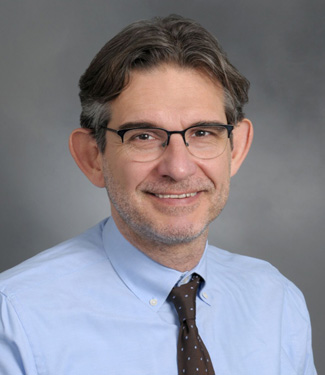
Dimitris Samaras, a SUNY Empire Innovation Professor in the Department of Computer Science at Stony Brook University, earned his Ph.D. in Computer Science from the University of Pennsylvania in 2001, following an M.S. from Northeastern University (1994) and a Diploma in Computer Engineering and Informatics from the University of Patras, Greece (1992). He also serves as director of the Computer Vision Lab and has held faculty positions at Stony Brook since 2000, progressing from Assistant to full Professor.
At the core of Professor Samaras’ research is the challenge of explaining and modeling visual data. His work spans computer vision, graphics, machine learning, medical imaging, and computational photography, with particular emphasis on the interplay between 3D shape and illumination—critical in applications like object recognition, shape and motion estimation, and augmented reality. He has also delved deeply into human modeling, notably facial appearance and expression under varying lighting for biometrics and HCI. These endeavors extend into interdisciplinary projects with psychologists using multimodal tools such as eye-trackers and fMRI to analyze human behavior, and the application of ML in brain imaging.
Professor Samaras is an acclaimed mentor and scholar. In 2023, he received Stony Brook University’s Outstanding Mentor Award in recognition of his exceptional guidance and support for faculty and students, who credit his accessibility, encouragement, and collegiality for their professional growth. He has also been honored with the SUNY Chancellor’s Award for Excellence in Scholarship & Creative Activities in 2018. On the research front, he is widely studied; metrics show he has a discipline specific H-index (DIndex) of 66 with over 14,000 citations, placing him among the world’s top-ranked scientists in AI, computer vision, and pattern recognition.
Looking ahead, Samaras is advancing large-scale foundational models in computational pathology, bridging AI with visual data to support diagnostic decision making by studying how experts interact with and interpret imagery. His broader reflections underscore the rapid advances in computer vision—driven by ubiquitous imaging devices, deep learning, and emerging multimodal vision-language models—while recognizing the ethical dimensions in human behavior analysis. He advocates for responsible use of such technologies, balancing innovation with privacy and consent.