Where young scholars take their first steps into real research
Home | Introduction | Sample Projects | Past Mentors | Application | News
Since its establishment in 2017, the Computer Science and Informatics Research Experience (CSIRE) program at Stony Brook University has grown into a nationally recognized model for early research training. Each summer, we welcome a group of highly motivated high-school students who are ready to move beyond textbooks and join real, ongoing scientific inquiry.
Over the past eight years, CSIRE has hosted more than 160 students, supported by over 20 faculty members from both the College of Engineering and Applied Sciences and the School of Medicine, representing six academic departments. Along with faculty mentors, a large team of dedicated PhD students also plays a critical role in guiding participants on a daily basis.
CSIRE offers a rare opportunity for young students to join active labs, build technical depth, and experience the joy and challenge of discovery.
A Research Focused Summer Experience
At CSIRE, students join active research groups and contribute to original, open-ended projects across areas such as machine learning and AI, biomedical informatics, medical imaging and computer vision, natural language processing, human-computer interaction and assisted technologies, algorithms and data science, computer systems and IoT, security and trustworthy computing, among others, represented by mentors from a broad network of mentors and research labs (See list of faculty mentors.)
Rather than following predefined assignments, students engage directly in real research. Over the course of the program, they learn to frame meaningful research questions, write and evaluate code for solving real-world problems, design and interpret experiments, communicate their findings effectively, collaborate with mentors and peers, and write research papers and technical reports.
Learning Beyond the Lab
To broaden scientific exposure, CSIRE also organizes:
- Research talks by faculty and senior researchers
- Career seminars (including insights from former CSIRE participants)
- Lab visits for commuting students
- Social activities that help students get to know each other and build supportive relationships with their mentors
This immersive environment allows high school researchers to develop both technical strength and scientific maturity.
The CSIRE Summer Symposium
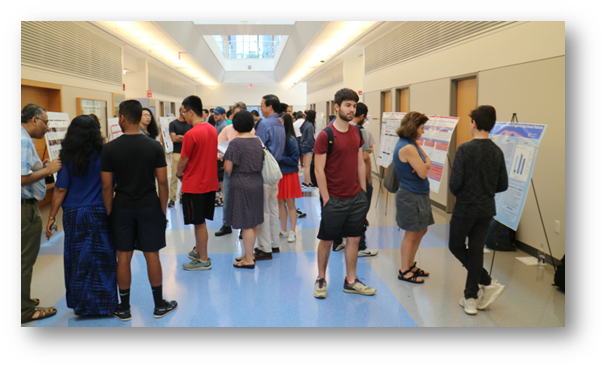
The program concludes with the CSIRE Research Symposium, where all participants present their summer projects to an audience of faculty, mentors, peers and families. For many, this is their first formal research talk, an opportunity to practice scientific communication, reflect on their work, and celebrate their achievements.
Beyond CSIRE: A Pathway to Continuous Research
Many students continue their research after the program, extending their projects during the academic year or maintaining collaboration with their mentors. This continuity often leads to:
- Earned regional, state, and national awards (including Regeneron Science Talent Search)
- Published papers
- Joined university labs as continuing researchers (including MITES)
- Entered top undergraduate programs
Notable examples of student publications include:
- Kaiyan Ling, Hang Zhao, Xiangmin Fan, Xiaohui Niu, Wenchao Yin, Yue Liu, Cui Wang, Xiaojun Bi (2024) " Model Touch Pointing and Detect Parkinson's Disease via a Mobile Game ". In Proceedings of the ACM on Interactive, Mobile, Wearable and Ubiquitous Technologies (IMWUT'24). Article No.: 74. Pages 1-24. (2025 Regeneron STS Scholar; now an MIT student)
- Weimin Lyu, Zexin Bi, Fusheng Wang, and Chao Chen: Unveiling the Vulnerabilities of In-Hospital Mortality Prediction Models to Backdoor Attacks. In Proceedings of AMIA 2024 Annual Symposium. November 9 - 13, 2024. San Francisco, USA. Best student paper finalist. (now a UPenn student)
- Sophia Lin, Xinyu Dong, and Fusheng Wang: FRISTS: High-Performing Interpretable Medical Prediction. In Proceedings of the 2024 IEEE International Conference on BigData (IEEE BigData 2024). December 15-18, 2024, Washington DC, USA (now a Harvard student).
- Daniel Kim, Wei Hou, Fusheng Wang, and Chrisa Arcan: Factors Affecting Obesity and Waist Circumference Among US Adults. Preventing Chronic Disease. Vol 16, 2019. Centers for Disease Control and Prevention PCD's Student Research Paper Contest Finalist (Yale alumnus).
- Daniel Kim, Fusheng Wang, and Chrisa Arcan: Geographic Association Between Income Inequality and Obesity Among Adults in New York State. Preventing Chronic Disease. Vol 15:180217, 2018.
High-quality CSIRE research may also be submitted to the International Symposium for Undergraduate and High School Researchers, a peer-reviewed research venue co-located with top international conferences. The 2025 symposium was co-located with the IEEE International Conference on Data Mining (ICDM) 2025, and the 2026 symposium will be co-located with the IEEE International Conference on Bioinformatics and Biomedicine (BIBM).
A Community of Curiosity and Care
CSIRE is more than a program—it is a community defined by curiosity, dedication, and mentorship. Students learn technical skills, but just as importantly, they learn how to think, persist, collaborate, and care. We believe that when young people are given authentic problems, trusted mentors, and the encouragement to explore with courage, they rise to extraordinary heights. We welcome all students who are ready to challenge themselves, grow as scientists, and take their first real steps into research.
Voices from Our Past Students
“My journey to a Stanford PhD started with CSIRE.” – Max
“My journey through a Stanford PhD started in a lab under the CSIRE program in high school, which gave me my first experience of mentored research in the summer of 2018. With experienced graduate mentors at CSIRE, I took my high-school research to the international science fair. This positive introduction to research encouraged me to pursue independent projects in college, where I continued using the skills learned during CSIRE. Without the mentorship and the CSIRE program, I would not have been introduced to such a high caliber of research in high school.”
“CSIRE was a turning point in my academic journey.” – Eric (UPenn CS freshman)
“My CSIRE experience in high school was one of the greatest milestones in my early academic career. Under the mentorship of Weimin, I received hands-on guidance with state-of-the-art NLP and machine-learning tools—exposure I would never have had access to anywhere else as a high-school student. Our project on LLM security was technically challenging and deeply relevant, and the work ultimately led to a publication at the AMIA Annual Symposium, where it was selected as a Best Student Paper finalist.”
“Beyond the research, CSIRE strengthened my presentation and scientific communication skills, pushing me to articulate complex ideas with clarity and confidence. The program played a foundational role in shaping my academic direction and accelerating my growth.”
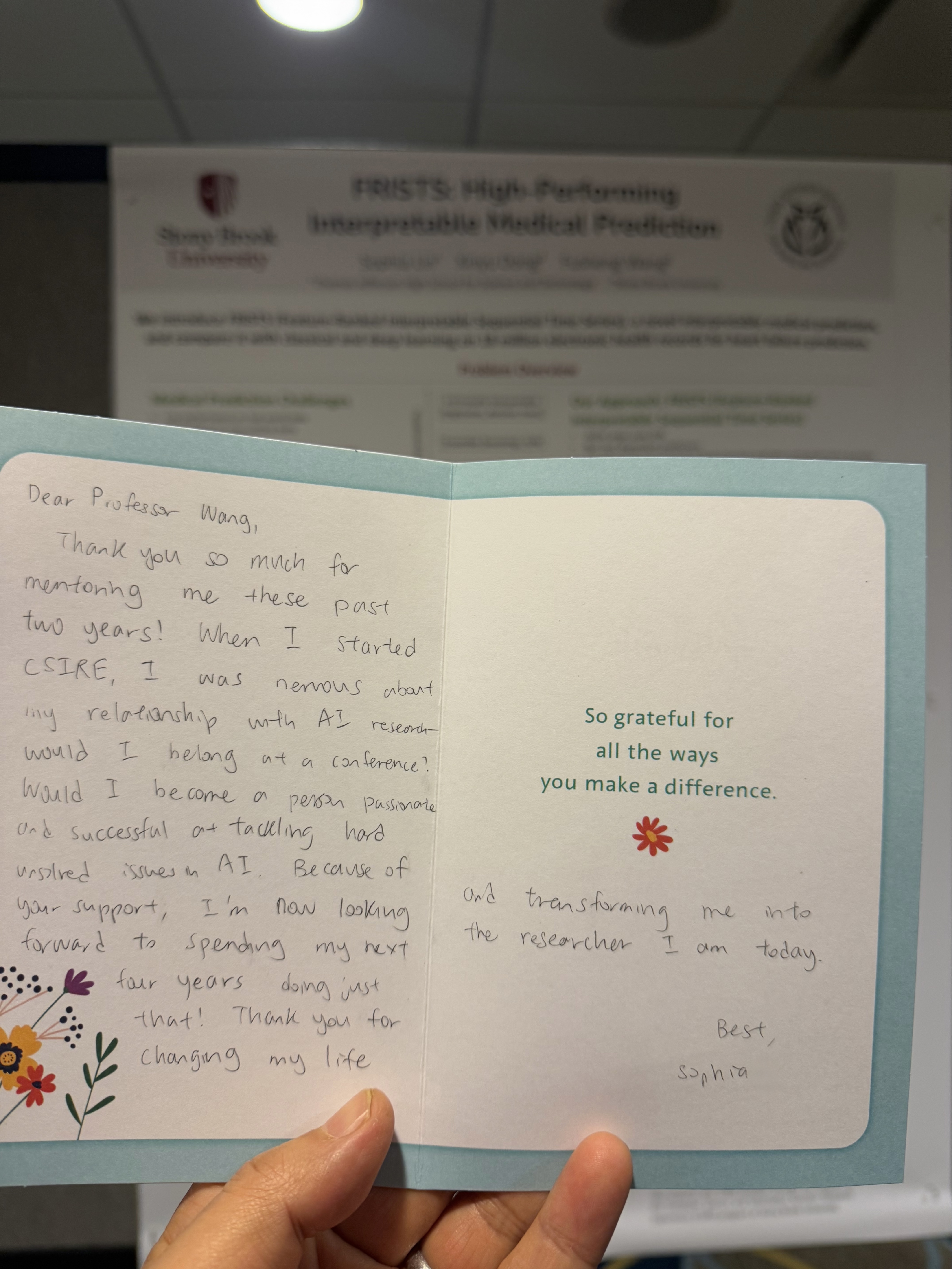
A Note of Gratitude – Sophia
“Dear Professor Wang,
Thank you so much for mentoring me these past two years! When I started CSIRE (in 2023), I was nervous about my relationship with AI research—Would I belong at a conference? Would I become a person passionate and successful at tackling hard unsolved issues in AI? Because of your support, I’m now looking forward to spending the next four years doing just that (at Harvard)!
Thank you for changing my life and transforming me into the researcher I am today.”